Did its last known location end up at one of these addresses in downtown Hamilton — right before your tracking stopped working?
…or maybe just somewhere in that general area?
You're not alone. And I'm sorry to tell you this:
your phone is gone.
My iPhone was stolen too. It was carried to this exact pocket of downtown Hamilton — Market St. near the corner of Hess St. N., in the neighbourhood called Central Hamilton. Then it was powered off — never to be seen again.
Afterward, I did my own research. This little area comes up again and again in Facebook groups and on Reddit — in posts going back years. Most of the victims aren't even from Hamilton. Their phones were stolen in Toronto or Vaughan, then driven here. People describe the same thing every time: the phone's dot stops moving near Market Street. Then it goes dark. Then it never comes back. (Read their stories below.)
Sometimes a stolen phone "wakes up" months later — pinging from the other side of the world, in places like China or Vietnam. By then, it has been wiped and resold. It is not coming home.
Honest answer: nobody knows for sure. There are two possibilities:
My bet is on the second one. But I want to be clear with you: that is only my guess. I cannot prove it, and this page does not accuse any specific person or place. (More on that at the bottom of the page.)
What I can tell you: if your phone went dark in this pocket of Hamilton, your chance of getting it back is close to zero.
The phone has already moved on somewhere else. The sooner you accept that, the sooner you can protect what actually matters now — your accounts, your photos, and your passwords. (See the checklist at the bottom.)
It started with a simple mistake — the kind any of us could make after a night out. Here is exactly what happened, minute by minute. Every time below comes from a real record: my Lyft receipt, my home router's logs, and Apple's Find My.
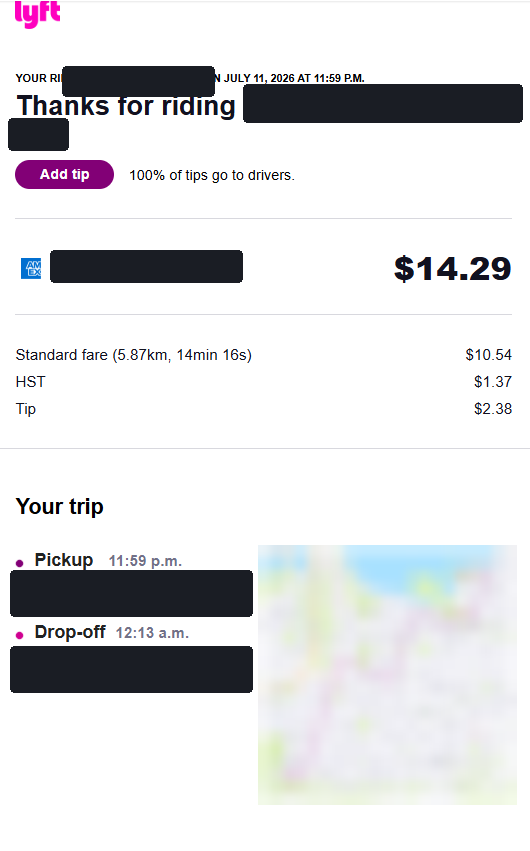
I got into a Lyft to go home. My phone was with me for the whole ride.
The Lyft dropped me off at my house. I got out and walked inside. My phone did not come with me — it had slipped out of my pocket and stayed on the seat.
Here's the wild part. While the Lyft sat parked in front of my house, my home Wi‑Fi router detected my iPhone — for exactly 46 seconds, at curb-strength signal. Then the car drove away, and my router never saw the phone again. The phone was in that car.
Inside the house, I reached for my pocket. Empty. My stomach dropped. I grabbed my wife's iPhone, signed in, and opened Find My — and watched my phone driving away down my street, following the exact route the Lyft took.
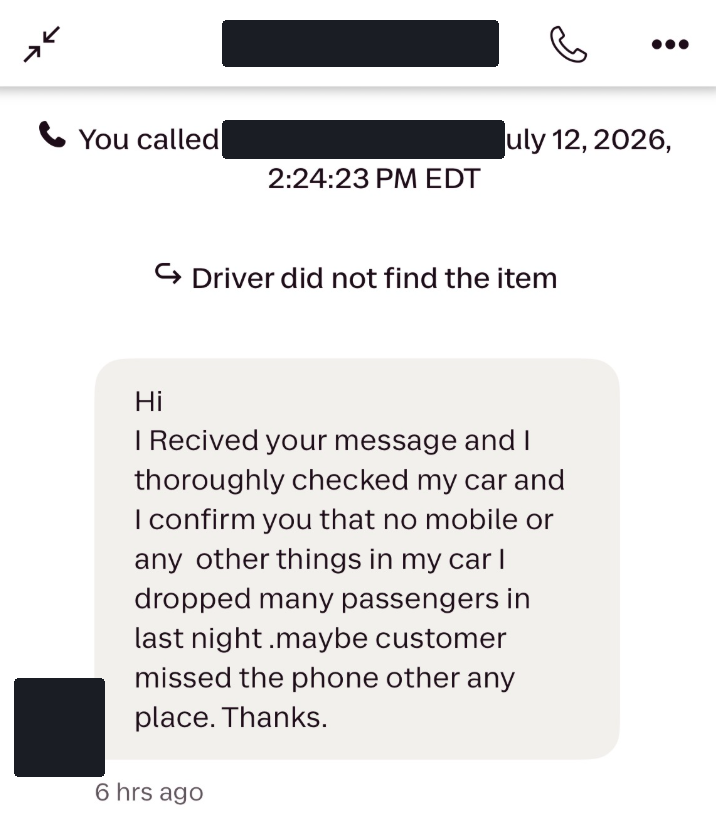
I messaged and called the driver through the Lyft app. I offered a $50 reward. I offered to meet him anywhere. The calls didn't connect.
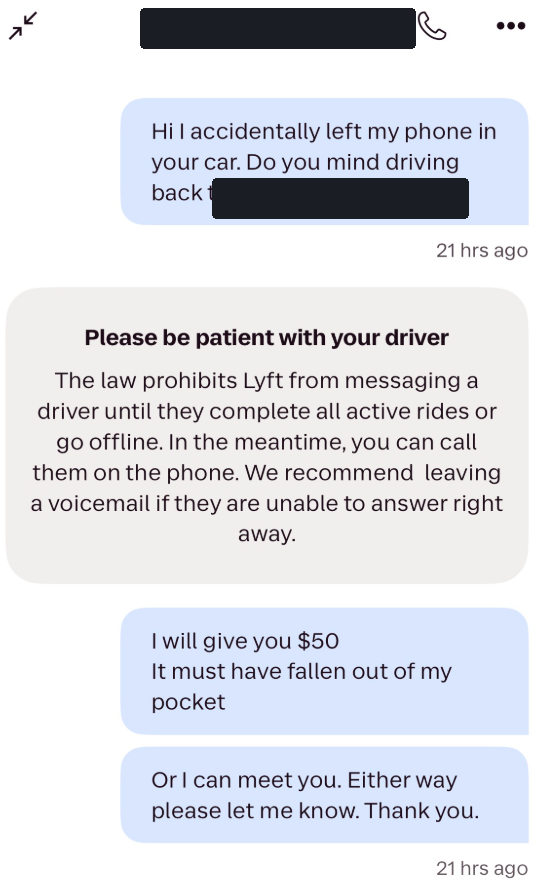
Twenty-three minutes after I got out of that car, my phone reported its location for the last time: 155 Market St., Hamilton, ON L8R 3H5. Then it was powered off.
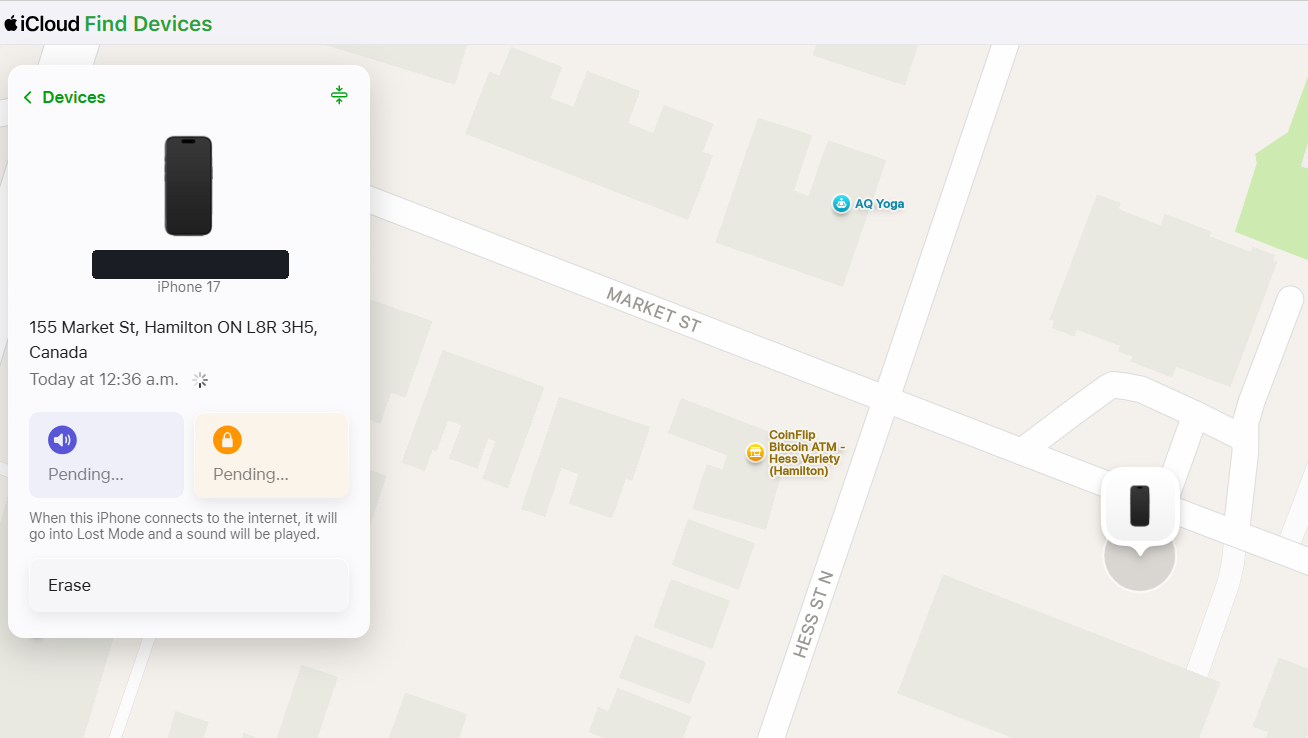
I opened a support ticket with Lyft while we kept trying the driver. His line was busy. Lyft said they would flag it as urgent.
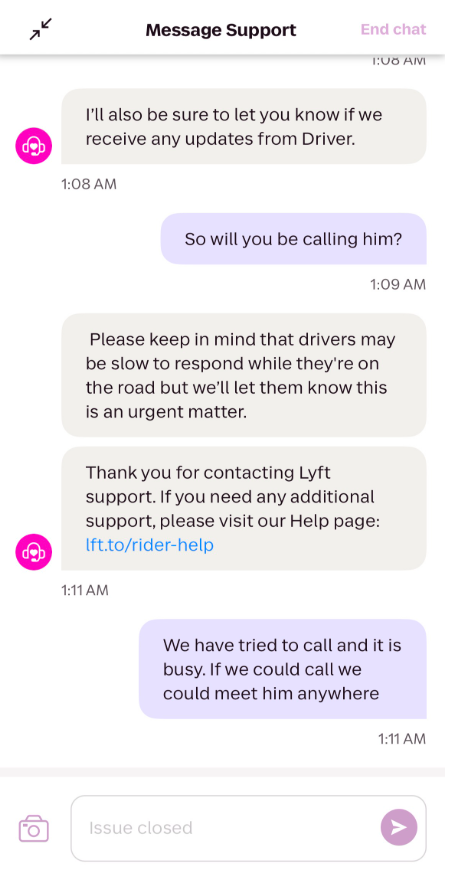
I finally reached the driver through the Lyft app. The app logged the result: "Driver did not find the item." He wrote back that he had checked his car and found no phone.
One last whisper. Apple's Find My network spotted my phone — still powered off — near 518 King St. E., Hamilton, ON L8N 1E2. It was already on the move. It has never been heard from since.
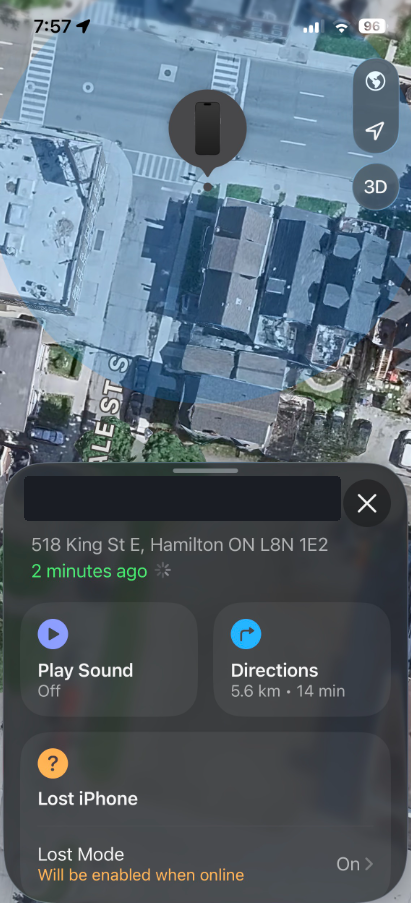
For the record, here is the ride itself — the trip receipt with the exact pickup and drop-off times that match my router's logs to the minute:
To be fair and clear: I am not accusing the driver — or anyone else — of stealing my phone. I honestly don't know whose hands took it. I only know what the records show: my phone stayed in that car, and 23 minutes later it went dark on Market Street. I gathered every record I could find — router logs, Lyft receipts and messages, and Find My screenshots — put them into an evidence binder, and filed a report with Hamilton Police.
After my phone vanished, I started reading. Reddit threads. Facebook groups. I found the same story, told over and over, by strangers who have never met.
A phone gets stolen — usually in Toronto, sometimes even farther away. Hours later, it pops up on Market St. in Hamilton. Then it goes dark.
Here are a few of those stories, retold in plain words. I removed every name and photo — these people didn't ask to be famous.
And these are only a handful. When I posted my own story in a Hamilton Facebook group, it drew more than 100 comments in a few days. One commenter said her daughter was mugged and her phone was tracked to this same spot — ten years ago. The oldest Reddit posts are from 2023. The newest are from this month. Same street. Same story. Every time.
In post after post, the pattern repeats. The phone goes dark on Market St. Weeks or months later, it wakes up one last time — in China, Vietnam, or Hong Kong. The phones move on quickly, and the dot on your map is usually old news — the last place your phone was heard from, not where it is right now. Chasing yours to Market St. means chasing a ghost.
One victim who called Hamilton Police was told they already had several reports about this location — but police can't search a whole building over phones. Neither can you. File your report online and let the reports pile up where they count.
One of the buildings in this pocket — 145 Market St. — is a seniors' residence. A staff member wrote publicly that phone-theft victims keep showing up at their door, some demanding to search residents' rooms. The residents are elderly. Most don't even use cellphones. The staff member put it plainly:
"Please don't come to our home, I promise you what I'm saying is true."
— staff member at the seniors' residence, in a public Facebook comment
These folks did nothing wrong. Your phone is not in their rooms. Please don't knock.
No. Please don't. By the time you could get there, the phone has almost always moved on. And knocking on doors around a spot tied to stolen phones is not safe. Staff at the seniors' residence on this block have publicly asked victims to stop showing up — the phones are not there. Mark the phone as lost and follow the checklist above instead.
The honest answer: almost never. Once a phone is powered off in this area, it is usually already on its way somewhere else. Spend your energy protecting your accounts and passwords instead — that part you can still win.
Thieves power the phone off to cut its cell and Wi‑Fi signals. That stops the phone from sending out its exact, live location.
But it may not go fully silent. Newer iPhones (iPhone 11 and up — but not the SE) keep sending a tiny Bluetooth signal for about a day after they're shut off. Some new Androids, like the Pixel 8 and up, do this too. When someone else's phone walks past yours, it quietly reports the location back to you.
So you may still see your phone on the map — just less often, and less exactly. Think "somewhere on this block, an hour ago," not a live dot. That's how my own phone was spotted one last time on King St. — hours after it was switched off.
Serious thieves go one step further: they wrap the phone in tinfoil or a signal-blocking pouch. Then even the Bluetooth whisper stops, and your map just keeps showing the last place the phone was heard from.
Through all of this, your data stays locked inside the phone. That's exactly why they may later try to trick you into unlocking it. See the next question.
No. It is a scam, and it often arrives days or weeks after the theft. The link leads to a fake Apple or Google page built to steal your password. Here's why: even a wiped phone stays locked to your account. The thieves need your password to unlock it from your account so it can be resold as a working phone — don't give it to them. Real alerts from Apple show up in the Find My app and in your Apple ID email — never as a text with a link. Delete it.
Two reasons: parts and pressure.
Parts. A locked phone is not worthless — it is a box of parts. The screen, battery, camera, and metal frame can all be sold. Reporters have followed stolen phones from cities like London all the way to one electronics market in Shenzhen, China, where locked phones are bought and taken apart. A locked iPhone there sells for about 30% of the price of an unlocked one. Less money — but far from zero. That is why "it's locked, so it's useless to them" is sadly not true.
Pressure. The thieves make the most money if the phone gets unlocked. They cannot break Apple's lock with technology — so they try to break you instead. This is where those fake "your iPhone has been found" texts come from (see the question above). Criminals can buy ready-made scam kits online — fake Apple pages, texting tools, even recorded voice calls — for as little as $5 to $50 per phone. One security team found more than 10,000 fake websites built just for this one trick. If you ever type your password into one of them, the thieves remove the lock, wipe the phone, and sell it at full price.
So the honest answer to "do they just want the parts?" is: parts are the backup plan. You are the main plan. As long as you never tap their links and never share your password, the most they will ever get is the backup plan.
Sources: Financial Times reporting via AppleInsider (2025) · Infoblox Threat Intel (2026) · Malwarebytes / Swiss NCSC (2025)
It means the phone was shipped overseas to be resold or stripped for parts. Many victims report exactly this. It also means the phone is not coming back — erase it remotely, add it to your police report if you have a file number, and move on.
Report it inside the app right away, so there is an official record, and call the driver through the app. Then watch the phone's location in Find My or Find Hub. If the dot stops at Market St. and the phone powers off — I'm sorry. Come back and read this page.